AI discovery
How to make your company and founder clear to search engines and AI assistants
Use one plain description of the company, its category and its founder, and repeat it consistently on your website, LinkedIn, directories and review sites.
Add Organization and Person structured data to your site with links to your official profiles. Make sure an About page and the founder's profile confirm each other. Fix outdated or conflicting descriptions wherever you find them.
Part of the ai discovery guides. Start with what AEO means for a B2B SaaS company.
What "entity" means here
Search engines and AI systems try to understand things, not just words: this company, this person, this product, and how they relate. A clear entity is one where every source agrees on the basics. A confused entity has different names, categories or founders in different places, and may be mixed up with another company of a similar name.
Start with one description
Write three versions and use them everywhere:
- One line: "[Company] is a [category] for [customer] that [specific outcome]."
- One paragraph: add who it is for, what makes it different, and where it is based.
- Founder line: "[Name] is the founder and CEO of [Company]. Before that, [relevant experience]."
Avoid shifting category language. If you call yourself "agent observability" on your site, do not call yourself "AI analytics" on LinkedIn.
Where the description needs to appear
| Place | What to check |
|---|---|
| Your homepage and About page | Category stated plainly in the first lines; founder named with a link to their profile |
| LinkedIn company page | Same one-line description; correct website, size, location |
| Founder's LinkedIn profile | Headline and About consistent with the company description |
| Crunchbase, G2, Capterra and similar | Current description, category, founding year, founder |
| GitHub, docs, app marketplaces | Same name and description |
| Podcast and press bios | Updated founder line |
Add structured data
On your site, add Organization structured data with your name, logo, URL, description and a sameAs list linking to your official profiles. Add Person structured data for the founder on the About page with sameAs links to their profiles. Google documents Organization markup, and schema.org defines both types.
Structured data does not guarantee anything. It removes ambiguity about which profiles belong to you. Google's AI features guidance says no special markup is required for those features, so treat schema as housekeeping, not a visibility trick.
An example you can inspect: this site
OwnedSignal uses the pattern described above, and you can check it in the page source:
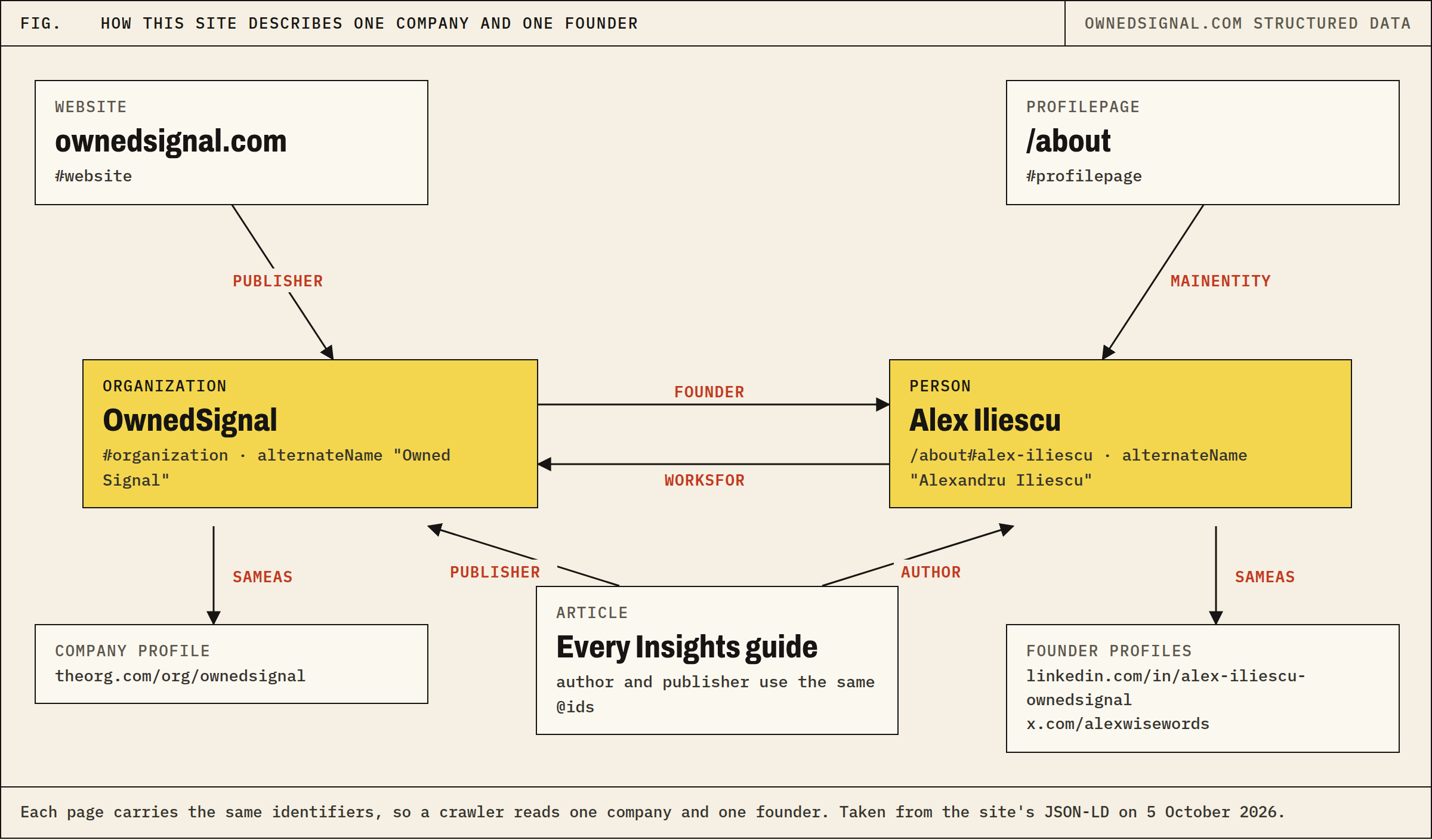
- The homepage and every page carry Organization structured data for OwnedSignal, with a founder property that points to a Person entity for Alex Iliescu.
- The About page is marked up as a profile page about Alex Iliescu, founder of OwnedSignal. It carries the Person entity, with worksFor pointing back to OwnedSignal and sameAs links to Alex's LinkedIn and X profiles.
- The Organization's sameAs links point only to company profiles whose description matches the current site.
- Every article names Alex as author and links to the About page, and its structured data uses the same Person identifier.
- The Organization lists "Owned Signal" as an alternate name, because third-party listings spell it both ways.
The same identifiers are used everywhere, so a crawler sees one company and one founder rather than several loosely related descriptions.
Make the founder and company confirm each other
- The About page names the founder and links to their profile.
- The founder's profile links to the company.
- Articles on the company site credit the founder by name where the material is theirs.
- Interviews and talks link back to the company site.
Clean up conflicts
Search your company name in Google and in two or three AI assistants. List every description that is out of date or wrong: old category, old pricing, previous product name, a former cofounder listed as current. Fix the ones you control. For third-party listings, request corrections.
Look for people and companies with the same name too. When OwnedSignal checked itself on 3 October 2026, a search tool's AI summary merged three different people named Alex Iliescu into one biography. The dated details are in how a SaaS company gets mentioned in ChatGPT answers.
A 60-minute checklist
- Write the three descriptions.
- Update your homepage, About page and LinkedIn company page.
- Update the founder's LinkedIn headline and About.
- Check and update your top three directory or review listings.
- Add or check Organization and Person structured data.
- Ask ChatGPT, Perplexity and Gemini what your company does, and note errors to fix.
Sources
- Organization structured data, Google Search Central.
- Organization and Person types, Schema.org.
- AI features and your website, Google Search Central, 2025-12-10. Re-read 5 October 2026.